Posts

PLAN Type 22 Missile boat

Image
PLAN Type 22 Missile boat

Air Force Squadron Patches

Image

Ukraine Integrate AGM-88 with Mig-29 & Su-27

How Did Ukraine Integrate ‘Incompatible’ AGM-88 Anti-Radiation Missiles With MiG-29 Fighters?

Attack of the 50 Foot Woman

Image

Do 335

Image

Amityville 1979 Movie poster

Image

Lion 106 of VF-213 Black Lions

Image

F-111

Image

B-2 bombers on flight line

Image

Tu-22 BLINDER (TUPOLEV)

Image
With performance roughly similar to that of the American B-58 Hustler, the BLINDER was capable of supersonic dash and cruises at high subsonic speeds, At least three major variants of the BLINDER entered operational service in the Soviet Air Forces � a free-fall bomber, an ASM carrier, and a photo/electronic reconnaissance variant. Tu-22 Blinder

Tu-22M BACKFIRE (TUPOLEV)

Image
The BACKFIRE is a long-range aircraft capable of performing nuclear strike, conventional attack, antiship, and reconnaissance missions. Its low-level penetration features make it a much more survivable system than its predecessors. Carrying either bombs or AS-4/KITCHEN air-to-surface missiles, it is a versatile strike aircraft, believed to be intended for theater attack in Europe and Asia but also potentially capable of intercontinental missions against the United States. The BACKFIRE can be equipped with probes to permit inflight refueling, which would further increase its range and flexibility. T-22M Backfire

CONVAIR F-102A "Delta Dagger"

Image
k The primary mission of the F-102 was to intercept and destroy enemy aircraft.  It was the world's first supersonic all-weather jet interceptor and the USAF's first operational delta-wing aircraft. The delta wing control surfaces eliminated the need for horizontal control surfaces (stabilizer and elevators). Built by Convair (General Dynamics); the F-102 was the first all-weather supersonic jet interceptor. First to use the 'area rule' design concept which pushed the speed beyond the sonic barrier, the F-102 was to be superseded by the more advanced F-106, which could exceed 1,000 mph. F-102

F-16 Fighting Falcon

Image
Genesis of the successful F-16 fighter/attack aircraft lies in reaction to severe deficiencies in US fighter design revealed by the Vietnam War. Following the success of the small, highly maneuverable F-86 day fighter in the Korean War, US fighter design changed to emphasize maximum speed, altitude, and radar capability at the expense of maneuverability, pilot vision, and other attributes needed for close combat. This trend reached its extremity in the McDonnell Douglas F-4 Phantom, which was the principal fighter for both the US Air Force and Navy during the latter part of the Vietnam War. F-16 Fighting Falcon

car from the league of extraordinary gentlemen (2003)

Image

YF-23 Black Widow II

Image
Two YF-23 prototypes were designed and built by the contractor team of Northrop and McDonnell Douglas as part of the demonstration and evaluation phase of the US Air Force's Advanced Tactical Fighter selection program, which concluded in 1990. According to the Air Force, factors in the selection for production of the F-22 were a better designed for maintainability, greater potential for future development, and slightly lower cost. A popular view is that the decision reflected a preference for maneuverability over stealth, and it is universally held that the YF-23 was by far the better looking aircraft. YF-23 Black Widow 2

F-22 Raptor

Image
The F-22 program is developing the next-generation air superiority fighter for the Air Force to counter emerging worldwide threats. It is designed to penetrate enemy airspace and achieve a first-look, first-kill capability against multiple targets. The F-22 is characterized by a low-observable, highly maneuverable airframe; advanced integrated avionics; and aerodynamic performance allowing supersonic cruise without afterburner F-22 Raptor

PHM 1 Pegasus

Image
PHM 1 Pegasus hydrofoil boats were designed to operate offensively against hostile surface combatants and other surface craft; and conduct surveillance, screening and special operations. The six PHMs of the Pegasus class formed a single squadron which operate from Key West. They were the Navy's fastest ships when foilborne and driven by their single gas turbine. PHM 1

English Electric Lightning F6

Image
The Lightning F.6 was the ultimate Lightning version of the RAF, with the first aircraft entering service with the newly formed No.5 Squadron at RAF Binbrook in December 1965. These aircraft were actually former F.3 aircraft brought up to F.6 (Interim) standard, also referred to as the Lightning F.3A and earlier as the 'Extended Range F.3'. The operational range of the early Lightning marks (F.1, F.1A and F.2) had been acknowledged as a critical factor even though the aircraft was initially developed for a specific home defence role English Lightening F6

American B-70 Valkyrie

Image
  With research and development studies b ginning in 1955, the XB-70 was a large, long-range strategic bomber was planned to be the replacement for the B-52. As in the B-58 program, the Air Force wanted new technology advances. To this end, the Air Force gave the prime contractor total weapon system responsibility. Competition between Boeing and North American for the contract occurred during the design phase. In 1958, the North American design was chosen and a development contract awarded. The Air Force requirement was for a Mach 3, high-altitude, long-range bomber capable of carrying nuclear and conventional weapons. https://nuke.fas.org/guide/usa/bomber/b-70.htm

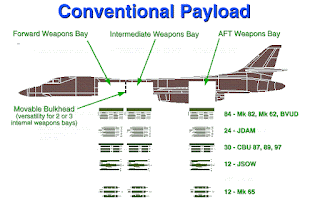
B-1B Conventional Payload

Image